
Character Loss
That answers the broad question—characters can be at risk beyond one fight—without establishing every condition that turns damage into a permanent departure.
Character death should not be collapsed into ordinary battlefield damage. Until the final rules are documented, the accurate wording is that injury and permanent loss are part of the stated stakes, not that any particular hit always kills a character.
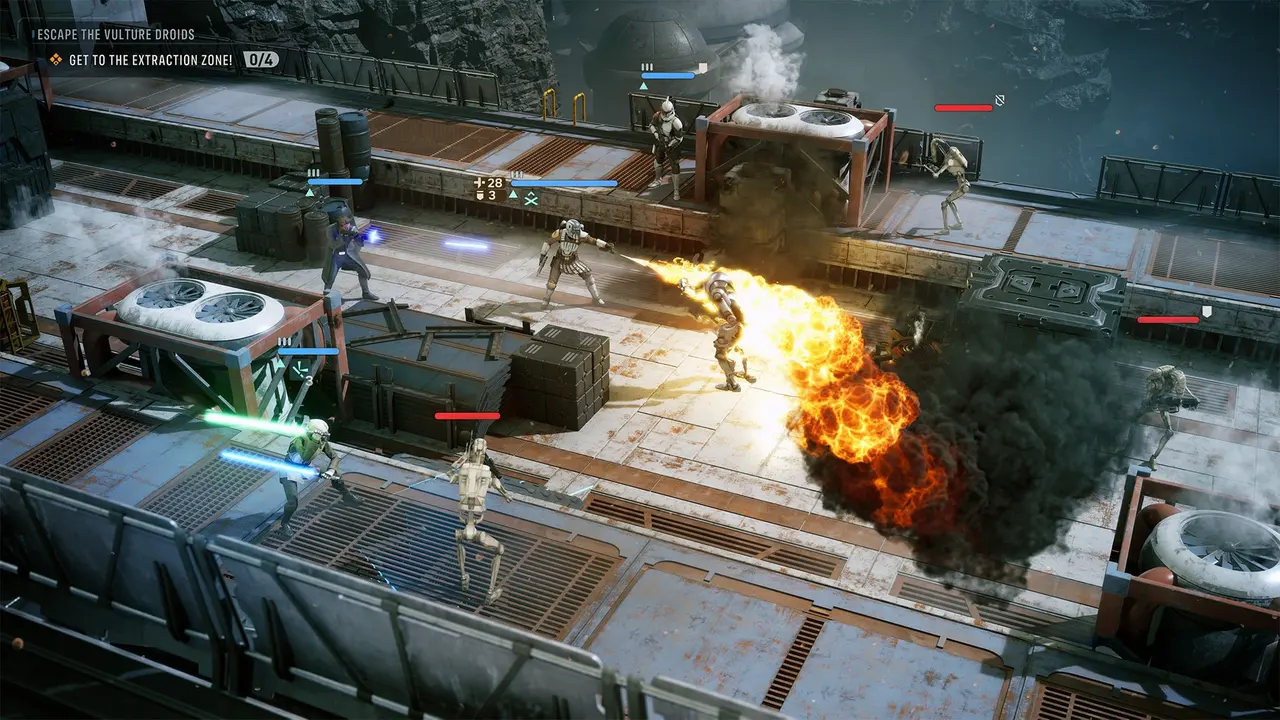
The industrial-platform screenshot places distinct operatives in separate combat positions opposite battle droids. It is relevant because the composition shows how one exposed squad member can become isolated. It contains no death-state label, wound counter, memorial screen, or recovery message, so it cannot tell us which visible combat outcome becomes permanent after the mission.
The question here is what happens to an individual character.
Injury Threshold
A screenshot of low health, a dramatic animation, or a previewer's account of a difficult mission cannot by itself establish the number of wounds allowed before death.
Threshold details matter because they determine how players interpret danger. A single incapacitation that leads to recovery creates a different decision from an accumulating wound system or an immediate permanent-loss state. Difficulty options could also modify those outcomes, but no complete modifier table is available here.
In the released game, inspect the terminology in the tutorial and results screen. If the interface distinguishes downed, injured, and lost, preserve those distinctions when writing or discussing the system. If a difficulty description changes casualty behavior, quote that option's scope rather than treating it as the rule for every campaign. This method avoids converting an early footage moment into a universal mechanic.
For historical pre-release planning, the only safe behavioral conclusion is to value survival. Keep vulnerable characters away from avoidable exposure and do not rely on a rumored wound allowance. That advice follows from the announced risk while remaining valid regardless of the undisclosed threshold.
Mission Survival
Keeping a character alive is a squad problem, not merely a health-bar problem. An exposed operative may force allies to spend actions on protection or rescue, weaken the formation, and reduce options for the objective. The long-term threat gives those costs more significance even before the final casualty formula is known.
A sound turn begins with visible information: enemy lanes, cover, remaining actions, objective pressure, and which teammate can respond if the plan fails. It does not begin with assumptions about a hidden rescue chance. When two routes achieve the same objective, the route that leaves the team able to react is generally the more robust choice for a campaign where loss can persist.
This does not mean every risky move is wrong. Tactical games sometimes reward accepting danger to stop a larger threat, and Zero Company's final mission design will determine those tradeoffs. The relevant point is that character risk belongs in the calculation. Players should decide deliberately when an objective justifies exposing a developed operative rather than treating all units as replaceable tokens.
Footage can demonstrate a formation or an enemy attack, but it cannot prove the post-mission consequence unless the complete state transition is shown and labeled. The page therefore uses combat imagery to discuss visible exposure while leaving the unseen death resolution open.
Character Death Boundaries
Narrative consequences are a separate unknown. None of those outcomes follows automatically from the phrase permanent operator loss.
Permanent loss can exist in a game that allows manual reloading, and an ironman mode can exist on its own of the casualty system. Without an announced save restriction, it would be misleading to claim that players are forced to accept every death or, conversely, that every result can be safely undone.
Recruitment and roster depth will shape the practical severity of death. A generous reserve makes loss recoverable in one way; a small named cast makes it consequential in another.
These gaps should influence purchase advice. A player attracted to consequential tactics can reasonably note the stated risk, while recognizing that frequency and control are still unknown.
Character Loss Questions
The most useful checks are concrete: what states exist between healthy and permanently lost, which states can be reversed, whether difficulty changes them, and what happens to equipment and progression after a loss.
Story questions need their own verification. Does dialogue acknowledge a fallen operative? Can a custom recruit replace the same battlefield role? Are named companions subject to different rules? A store page that labels the game single-player cannot answer those questions, and promotional key art cannot answer them either.
Version and context matter when launch coverage appears. A reviewer playing a preview build may observe rules that later change; a difficulty-specific example may not describe the default campaign. Reliable reporting should name the build, setting, and sequence that produced the result.
Checked references
Sources and verification
Facts on this page were checked against the following first-party material and named post-launch coverage.