
The Current Mode Label
Steam likewise categorizes the PC product for single-player use. Neither page presents multiplayer as a second headline mode or as an included feature beside the campaign.
They do not advertise player-versus-player battles, online co-op, local co-op, split-screen, LAN play, matchmaking, cross-play, shared progression, or a second player controlling a squad member. Avoid filling any of those gaps from genre expectations.
A lightsaber bearer occupies the left edge, two armored figures lead the center, and a rifle-carrying operative advances on the right. The composition establishes an ensemble under battlefield pressure; it contains no player names, lobby, controller prompt, connection icon, or divided screen.
Multiple characters can be commanded by one person. A group in the story is not a statement about how many humans can connect to the software.
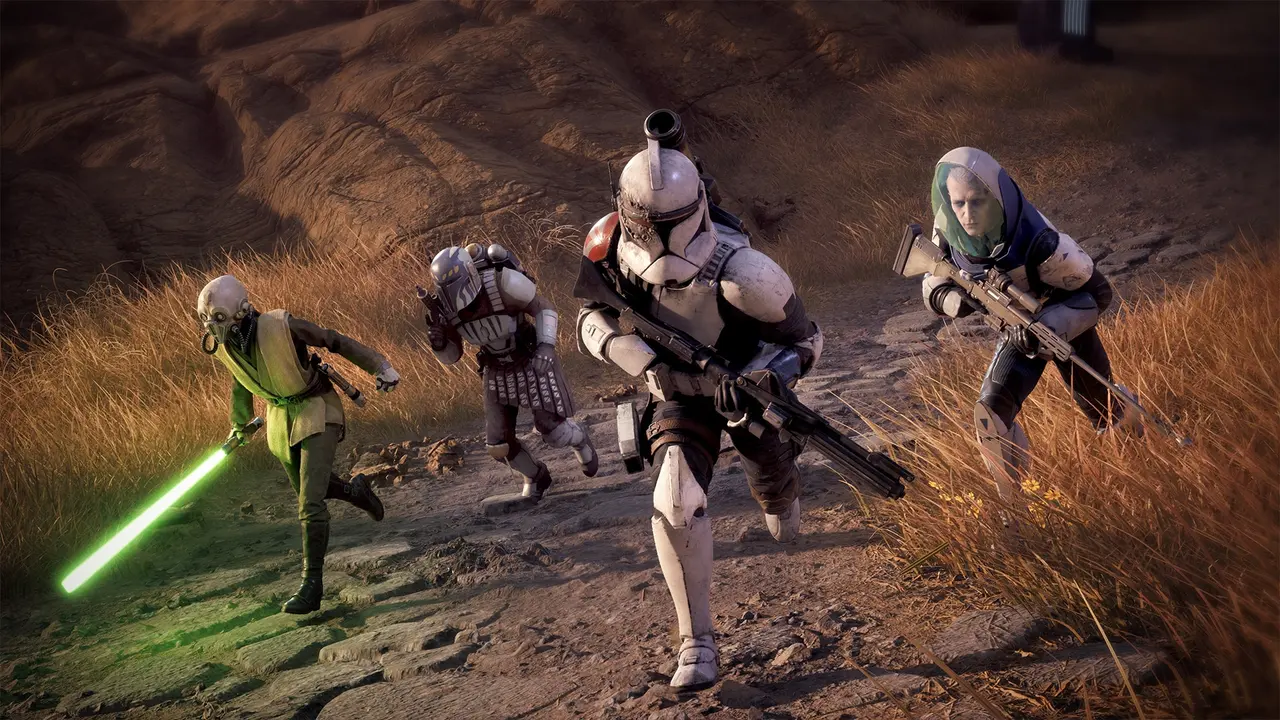

Why a Squad Does Not Mean Multiplayer
Hawks leads Zero Company as part of a cinematic campaign. Each phrase concerns the in-game roster and its systems; none assigns an operative to another human participant.
Turn-based tactics often presents several controllable units on one battlefield. Unit count, simultaneous animation, or a formation of characters cannot override it.
Bonds are also not a social-play feature. Calling those relationships cooperative would confuse characters working together with two users sharing control, accounts, or a session.
The announcement trailer uses squad scenes to sell the story and tactical premise. Edited shots of several operatives still do not demonstrate a network lobby, local handoff, matchmaking flow, or multiplayer interface.
This prevents the same promotional image from producing contradictory mode claims on different pages.
Accounts and Internet Are Separate Questions
The listing presents those conditions separately from its single-player feature label and does not describe them as a way for another person to join the campaign.
An online requirement and an online multiplayer mode answer different questions. The first concerns what the software or storefront needs from one owner; the second concerns whether multiple owners or users can play together or against one another. Only explicit product language should bridge that gap.
The reverse inference is unsafe as well. Players who need offline play should check the exact platform's current connection and account terms rather than assuming that lack of multiplayer removes every network dependency.
Store community features are not game modes either. Achievements, cloud saves, friends lists, broadcasting, discussion boards, or platform overlays may accompany a single-player product without adding cooperative or competitive control. This page makes no claim about a feature unless the Zero Company listing names it.
Cross-save and cross-progression should also stay outside the multiplayer answer. They concern continuity of one player's data across environments, not shared play, and neither is established merely because the title appears on PC, PlayStation 5, and Xbox Series platforms.
What Would Count as a Status Change
A retailer keyword, database tag, forum post, or squad screenshot would not be enough on its own.
Any new claim would also need its own scope. Online co-op, local co-op, PvP, asynchronous challenges, and shared campaign control are different implementations. Confirmation of one would not confirm the others, and support on one platform would not automatically establish support everywhere.
If playing with friends is mandatory, do not purchase on the assumption that another mode is hidden, implied by account requirements, or certain to arrive later.
A player who simply wants to discuss choices, stream a session, or pass a controller informally may still make the experience social outside the software. Those activities do not change the product's mode classification and are not equivalent to supported cooperative play.
Checked references
Sources and verification
Facts on this page were checked against the following first-party material and named post-launch coverage.