
XCOM Combat Model
The XCOM comparison is useful at the level of genre: Zero Company is a turn-based squad tactics game where cover, positioning, target order, and abilities shape an encounter. A player who enjoys pausing to solve a dangerous battlefield is looking in the right category.
That resemblance is not a rules import. A familiar camera angle and grid-like battlefield can establish a shared tactical vocabulary without making two games mechanically interchangeable.
Its composition supports the basic comparison—small-unit positioning under ranged pressure—but no readable percentage, action pip, cover icon, or turn-order rule appears. The image cannot be used to copy XCOM math into Zero Company.
Use the analogy to set a play-style expectation, then judge Zero Company by its own documented systems. The relevant purchase question is whether deliberate squad risk appeals to you alongside this game's Clone Wars narrative and characters, not whether every habit from another franchise transfers unchanged.
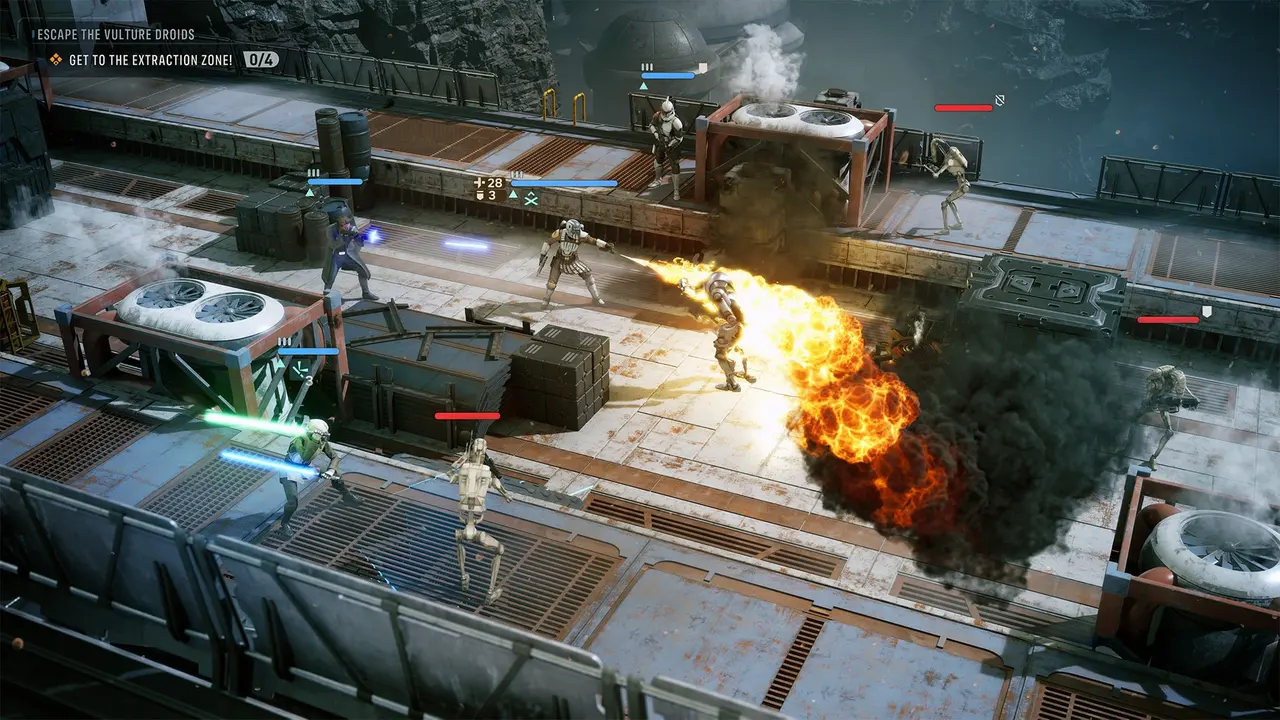
Cover And Turn Order
Cover matters because location changes the relationship between an operative and incoming threats. Target order matters because an early action can remove danger or create an opening for the rest of the team. Both ideas are visible in Zero Company's tactical presentation and familiar to XCOM players.
The exact implementation remains Zero Company's own. Do not assume that visual cover has the same binary categories, that a percentage displayed in one game means the same calculation, or that units share identical movement-and-attack restrictions. Release-build tooltips and tutorials should decide those questions.
A transferable thinking habit is to plan the whole turn before committing its first irreversible action. Identify the target that constrains the squad, the safest positions that preserve sight lines, and the ally who can follow up. If the first move fails, know what response remains. This method does not depend on a specific action-point formula.
Turn order may refer to the order in which the player activates squad members, enemy sequencing, or a more explicit initiative system.
Zero Company Differences
Zero Company distinguishes itself first through setting and squad identity. Hawks leads an original company during the twilight of the Clone Wars, and the published pitch connects tactical operations with investigations, relationships, and character development.
Bonds and ability combinations give the team a relationship-centered framing. Advantage is presented as a resource involved in team decisions. Those terms should be learned from Zero Company's own explanations rather than translated into an XCOM meter or class feature merely because both games reward coordinated actions.
The roster also draws on Star Wars character types and customization. That changes the fantasy of the campaign even where the tactical decision—move to safety, set up an ally, remove a dangerous enemy—feels familiar. Story attachment and the composition of Zero Company may be as important to player fit as the geometry of cover.
Differences that are not yet documented should stay open.
Comparison Boundaries
Several common comparison claims go too far. A cover-focused screenshot cannot reveal the probability formula. A squad on screen cannot prove the deployment cap. A cinematic casualty cannot define the injury threshold, and a familiar mission view cannot establish difficulty presets.
Videos are useful when they show a complete labeled interaction. Even then, record what is visible instead of naming an unseen rule. An attack followed by an ally action can demonstrate sequencing in that captured build; it does not prove every cooldown, modifier, or alternate outcome.
Third-party commentary should remain attributed.
The clean boundary is simple: compare the experience promised—turn-based squad planning under cover and pressure—while verifying every number, mode, and campaign subsystem inside Zero Company itself.
Player Fit
This comparison is most helpful for deciding whether the pacing fits. Players who like surveying a map, weighing risk, coordinating specialists, and accepting campaign consequences have clear reasons to follow Zero Company. Players seeking real-time action or a multiplayer squad should not infer those experiences from the Star Wars combat imagery.
An XCOM veteran should expect to relearn details. Familiar tactical instincts may shorten the orientation period, but relying on remembered percentages or activation rules can produce bad decisions.
Players new to XCOM do not need knowledge of that series to understand Zero Company. The comparison is a genre shortcut, not a prerequisite.
A final buying judgment should combine tactical taste with interest in this specific squad and narrative. If only mechanical identity matters, wait for detailed release coverage that compares complete systems. If deliberate Star Wars squad tactics is the appeal, the confirmed overlap already answers the broad fit question without promising a clone.
Checked references
Sources and verification
Facts on this page were checked against the following first-party material and named post-launch coverage.