
Squad Campaign Loop
Zero Company works as a single-player squad-tactics campaign. Hawks leads operatives through turn-based battlefield missions, while the broader campaign includes investigations, squad development, bonds, and an original Clone Wars story.
That structure creates two connected scales of decision. During an operation, the player chooses positions, targets, and ability order. Between operations, attention returns to the people and capabilities that make the next mission possible.
Its composition supports the mission half of the loop: several squad members occupy different lanes and must act as a team. It does not depict an investigation screen, progression tree, resource cost, or exact campaign sequence.
A useful mental model is prepare, deploy, resolve, and develop. Those words summarize the announced campaign rhythm rather than claim four named game phases. The shipped interface may divide or label the process differently, so this page describes function instead of inventing menu terminology.
The result is not a hero-action game with companions acting only as scenery. The player commands a squad in deliberate turns and carries that team through a story campaign.
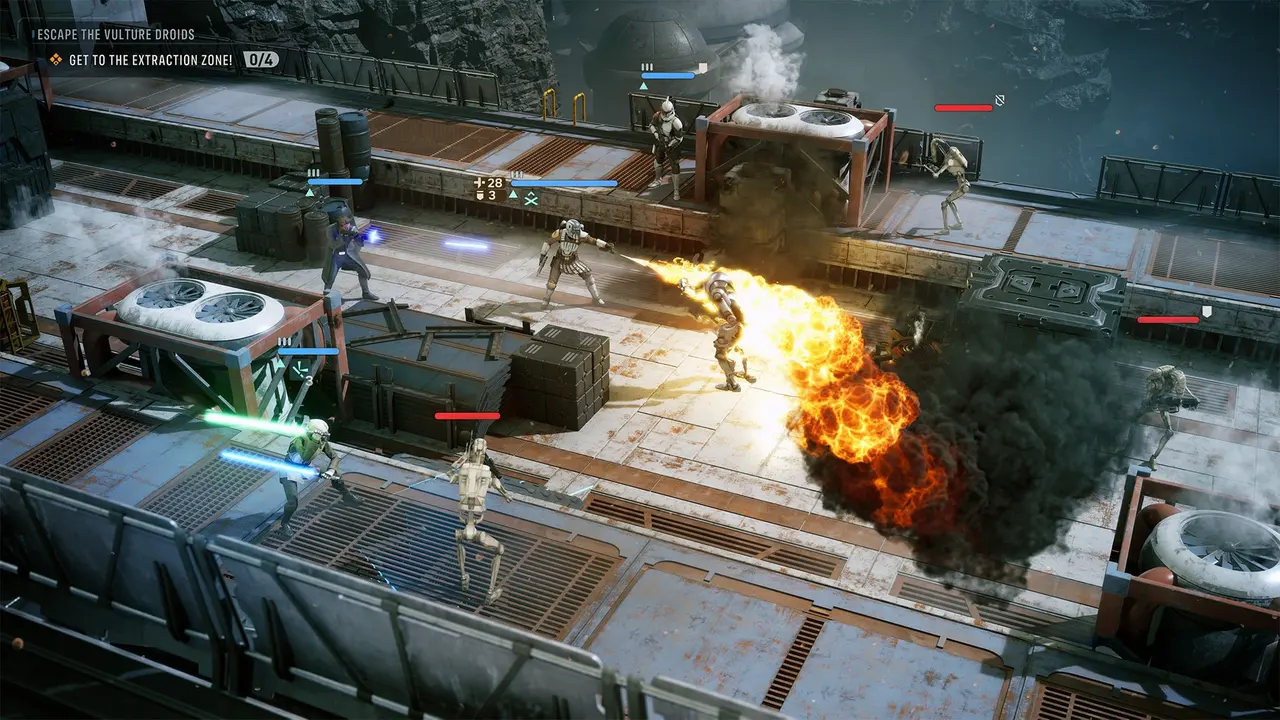
Battlefield Actions
On the battlefield, actions are chosen in turns rather than executed through continuous real-time control. Positioning and cover shape which threats can reach an operative, while target order determines whether later squad members act under pressure or exploit an opening.
Read the objective before building an attack sequence. A mission may reward removing a dangerous enemy, reaching a location, protecting the squad, or preserving enough options to respond.
Ability order is a team question. One operative can create a condition another uses, so the first action should be judged partly by what it enables.
Good turn planning keeps a fallback. Identify the primary threat, the ally who can follow up, and the action that remains if the opening move fails. This is a planning method, not a claim that Zero Company uses another tactics game's action points, reactions, or hit formula.
End the turn by checking the squad's resulting positions rather than only the damage dealt. An isolated operative can create a campaign problem if injuries and loss persist, but this page does not infer the casualty thresholds or recovery rules from that general risk.
Between Mission Development
Between missions, Zero Company's focus returns to the squad and campaign.
Development should be understood broadly until the final systems are documented. A promotional character build may also come from a later campaign state.
Bonds connect character relationships to squad capability in the published description.
Investigations give the campaign a layer beyond combat, tying operations to the emerging threat in the story. The available pages do not specify the exact interface, failure states, or whether every investigation branches. It is accurate to include investigations in the loop and inaccurate to invent their rules.
For a player, the practical cycle is to evaluate what the last mission revealed, adjust the squad within the options actually available, and prepare for the next objective. The final build will determine how much freedom and time each stage receives.
Advantage Decisions
Advantage is presented as a tactical resource used for team decisions. That framing matters because spending it should be evaluated against the whole squad's turn, not only the operative who triggers the immediate action.
An early use can help remove a dangerous target or establish control, while saving the resource may preserve an answer for a rescue or finishing sequence. These are examples of decision context, not claims about a published meter size, generation rate, or named action cost.
Before spending Advantage, ask what the team gains now, which later option disappears, and whether an ordinary action can solve the same problem. Resource value depends on timing and mission pressure. The final tooltips are the authority for legal uses and exact effects.
It can support interactions that are visibly labeled, but trailer editing and captured progression state still limit what can be generalized.
In short, Zero Company alternates turn-based squad operations with campaign development around Hawks and the team. Advantage helps coordinate tactical decisions within that structure. Unpublished formulas, exhaustive progression rules, and assumptions borrowed from other games remain outside the answer.
Checked references
Sources and verification
Facts on this page were checked against the following first-party material and named post-launch coverage.