
Exotic Class Status
The phrase appears to be a player search term for unusual squad members or roles, not a published menu label.
A Jedi, scoundrel, or astromech may feel unusual beside conventional soldiers; that impression does not turn those identities into one formal class family.
Different silhouettes and positions reinforce the idea of a mixed squad, yet the image has no class-selection menu, role label, skill tree, or unlock requirement. It is useful visual context for variety and nothing more.
This distinction matters for searches that ask which exotic class is best. Ranking a fan-created category would imply that its members and rules are already known.
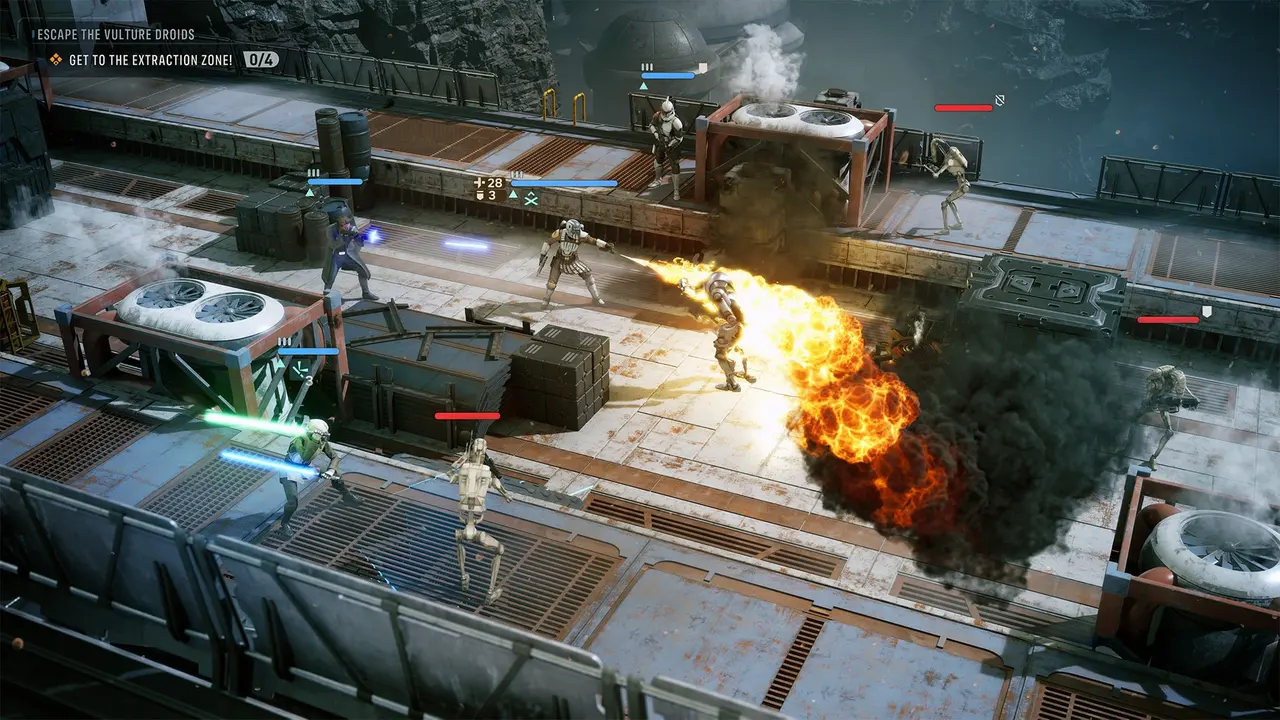
Announced Operator Types
The published squad description names broad Star Wars identities such as scoundrels, astromechs, and a Jedi. Those examples show thematic range. They do not reveal whether the game calls each identity a class, origin, species, archetype, companion type, or something else in its interface.
A character identity and a tactical role can also be different layers. An astromech might be visually and narratively distinct while its battlefield contribution is expressed through skills; a Jedi label may describe the character fantasy without telling us every specialization available. Until the UI is documented, it is safer to talk about announced operator types and visible functions separately.
Players interested in unusual squads can still use the confirmed information. Zero Company is not presented as a roster of identical troopers, and customization is part of its pitch. What cannot yet be answered is how many unconventional options exist, which are recruitable, whether they are fixed companions, and how their progression compares.
The IGN preview video can add observed class and squad context, but it should remain attributed to that preview.
Unlock List Boundary
Counts, unlock conditions, and final labels remain unknown. The reviewed pages do not say that a special role unlocks after a particular mission, requires a difficulty setting, belongs to an edition, or can be selected during initial character creation.
That absence rules out several common shortcuts. A brief figure in a trailer is not proof of a playable class. A cosmetic pack does not establish a gameplay archetype. A character mentioned in story copy is not necessarily recruitable, and a preview loadout does not prove when the same option becomes available in a normal campaign.
Search snippets and unlabeled clips remain leads to verify, not entries in a table.
For every claimed option, record the game's own label, the eligible operator, any prerequisite, and the visible result. If one of those fields is missing, describe the character or ability without promoting it to an exotic class.
Class Confirmation
Confirmation also requires scope. A named role may belong to one companion rather than being selectable for a custom operative. A character may combine a background with a weapon specialization. Two characters with similar attacks may still progress through different systems. A final roster should preserve those distinctions instead of flattening them into a convenient list.
If a preview only shows one encounter, say that the role was observed there.
This approach does not make the page less useful. It tells readers that the game promises a heterogeneous team while preventing a speculative label from becoming a fake feature.
Roster Follow Up
Future roster information should be organized by the names the game actually publishes. Useful fields include whether an option is a fixed companion or a custom-operative choice, its stated battlefield role, the skills shown, any weapon relationship, and the documented access condition.
The first follow-up check is taxonomy: does Zero Company use class, archetype, specialization, talent tree, or another term? The second is availability: who can use it and when? The third is function: what confirmed actions or synergies distinguish it? These questions produce a practical guide without depending on the word exotic.
A visually rare character is not necessarily more powerful, and an unusual ability is not automatically an endgame unlock. Rankings should wait for complete descriptions and repeatable release-build observations rather than promotional cuts selected for spectacle.
For now, readers can expect a varied Star Wars squad that includes markedly different character types. That is the full answer to the search, and it keeps future updates easy to add without rewriting speculation as correction.
Checked references
Sources and verification
Facts on this page were checked against the following first-party material and named post-launch coverage.